

The Second Surface
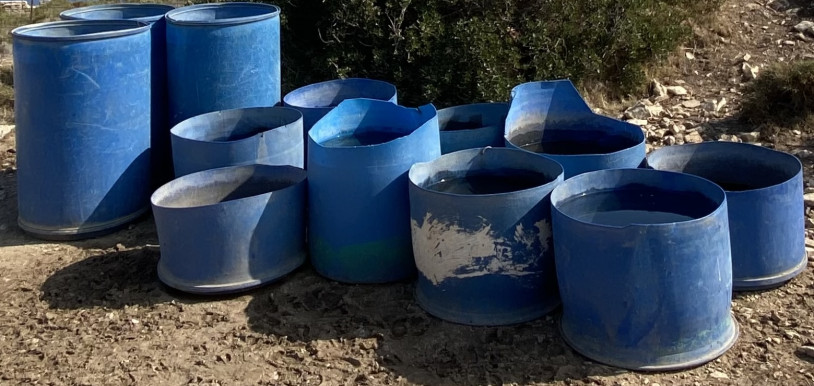
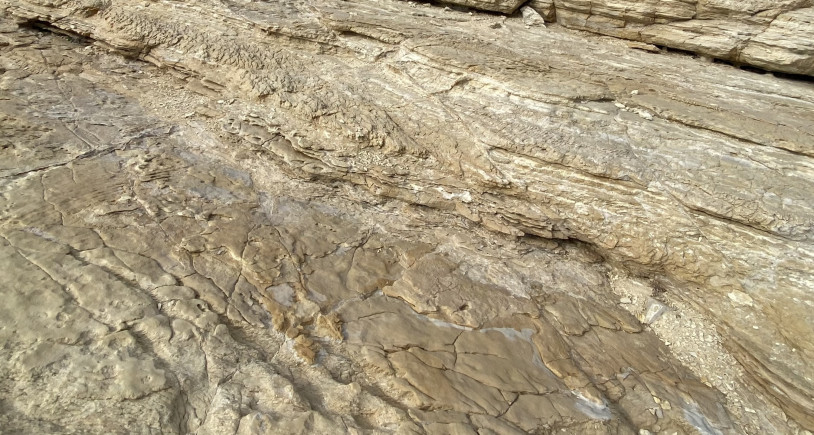
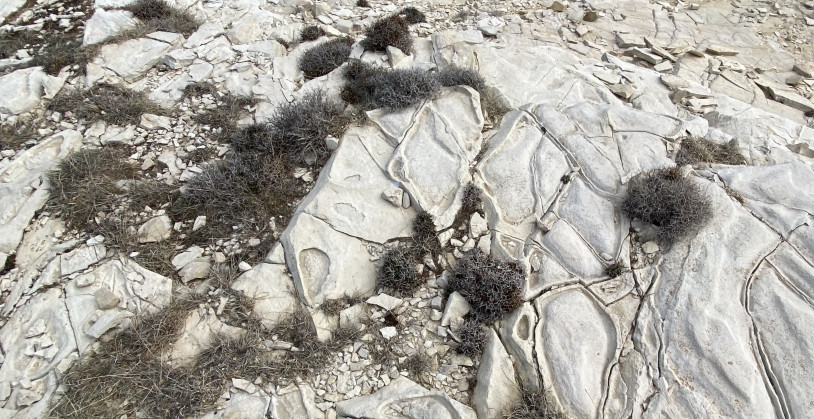
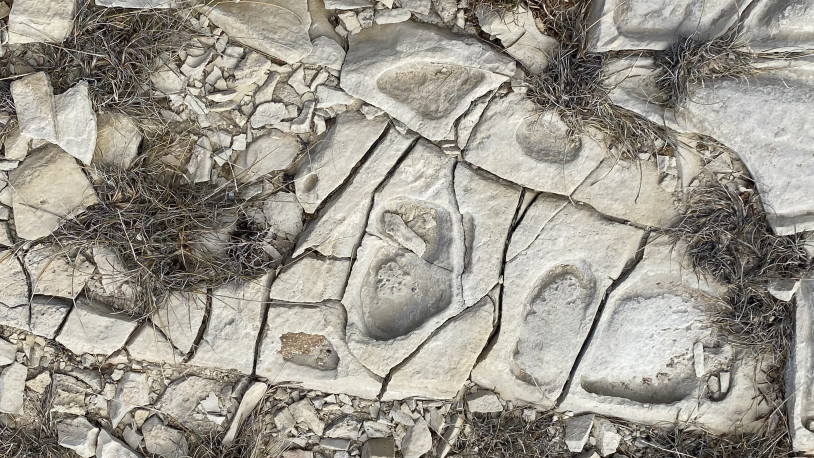
In 2483, on the island of Lipsi, deep core drilling was authorised after a three-dimensional survey revealed the recurrence of the same geometric pattern in fractures across the coastal rock pavements. Seven irregular segments formed a recognisable outline on surfaces hundreds of metres apart. Some fractures extended into ancient rock formations; others cut through rocks affected by more recent erosion. The drilling was intended to establish whether this geometry continued underground. The cores, cylinders eight centimetres in diameter, would undergo tomography, petrographic microscopy and isotopic analysis.
↓ 0–18 m
Fractured limestones, veins of secondary calcite and cavities formed by dissolution. Within one vein, a heptagonal opening just a few micrometres wide came into view. Crystals had grown regularly along its perimeter without entering it. Tomography detected no matter, but neither did it reveal a measurable volume. It was as though the rock had formed around a space that did not belong to it.
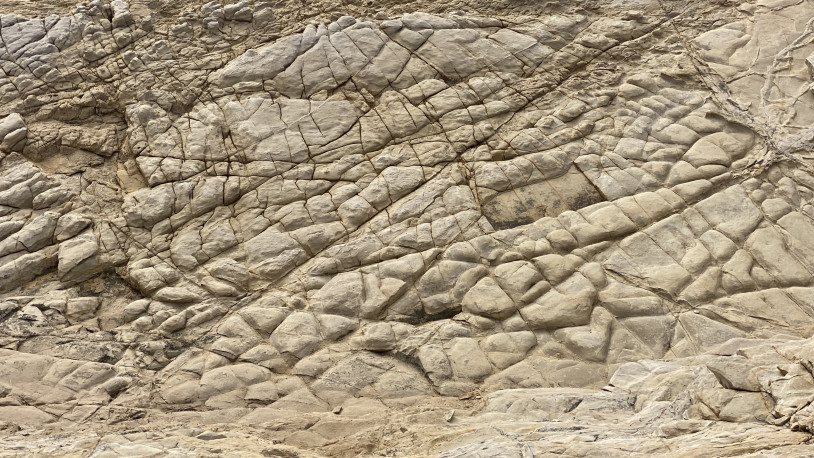
↓ 18–111 m
Finely laminated lacustrine sediments containing fossil molluscs and siliceous microstructures. The same figure appeared inside a mineralised shell. Its growth lines followed the seven sides, indicating that the organism had built its shell around a pre-existing discontinuity. The anomaly therefore predated the fossil that enclosed it.
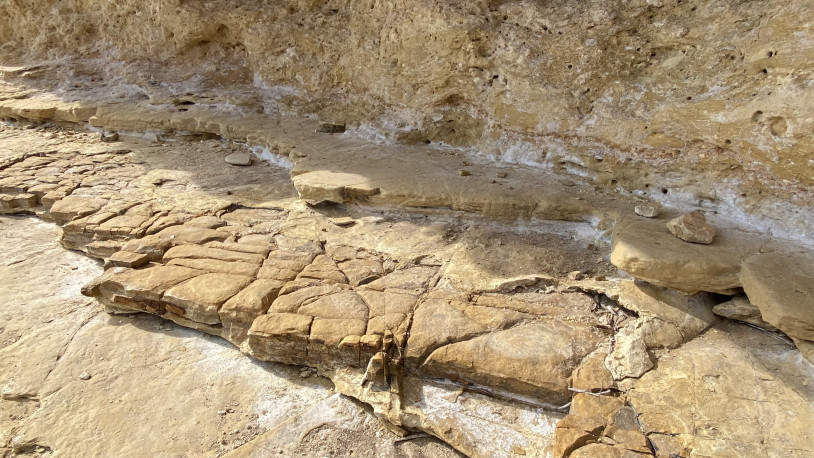
↓ 112 m
A tectonic breccia marked the contact between formations that had originally been separate. Two fragments displaced along a fault plane each preserved part of the heptagon. When reassembled, their margins aligned, yet an interval between them remained impossible to measure. Movement of the crust had separated the rock without altering the figure’s proportions.
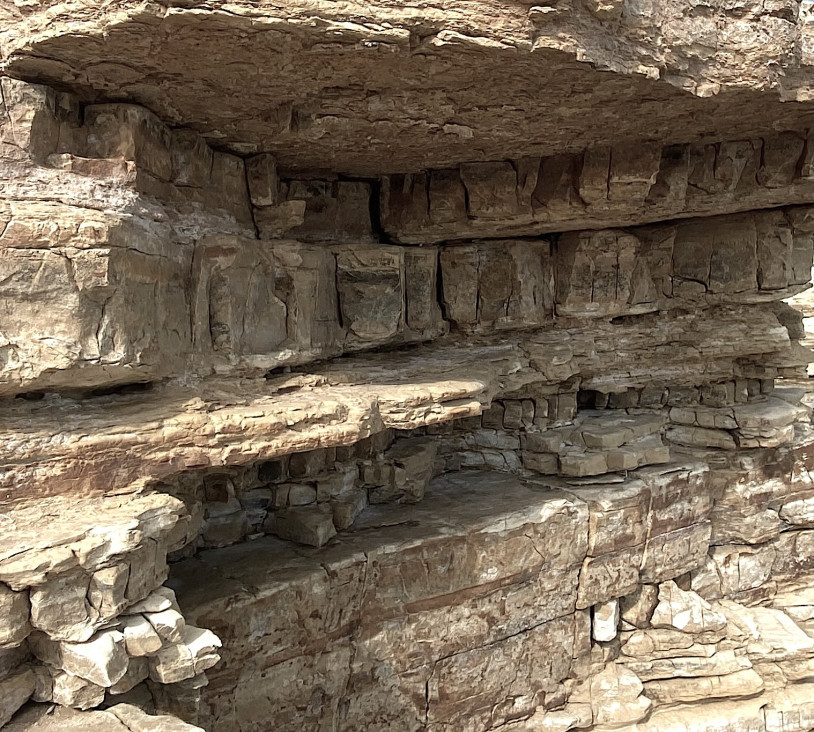
↓ 680 m
Phyllites, mica schists and quartzites with assemblages of phengite, chlorite, epidote and quartz. The rocks preserved foliations and deformation structures formed during metamorphism. The heptagonal opening, however, remained unchanged. Under compression, the specimen deformed around it without altering its angles.
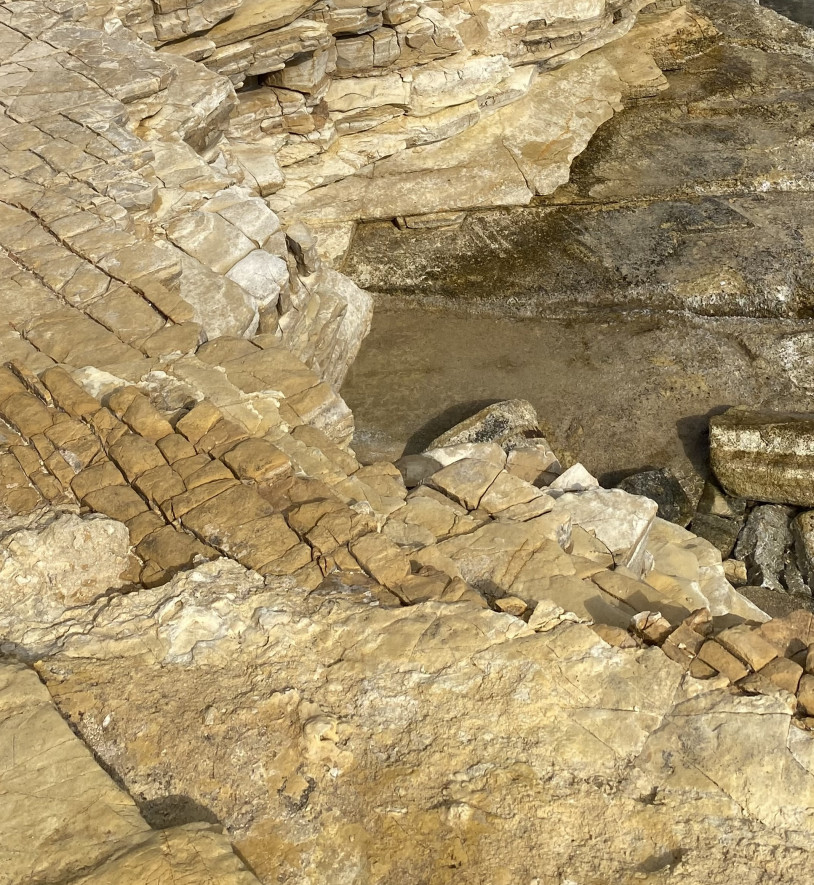
↓ 2,140 m
Garnet- and plagioclase-bearing gneiss, with fractures filled by quartz fibres that had grown during successive phases of metamorphism. In one garnet crystal, the anomaly occupied almost the entire cross-section. The crystal was split lengthwise: the two halves fitted together, yet the depths of their interiors differed. Instruments recorded a discrepancy between the specimen’s external dimensions and the extent of the space enclosed within it.
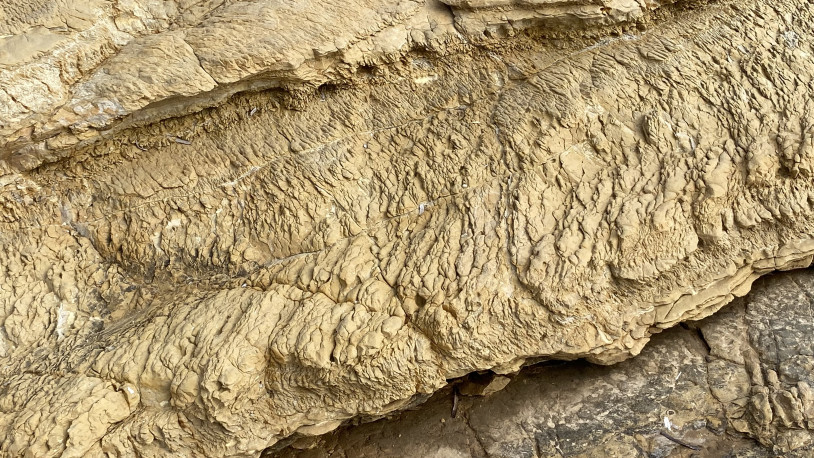
↓ 7,300 m
An unclassifiable mineral aggregate appeared, composed of quartz and magnetite around a central opening. Aragonite concretions threaded with organic filaments grew on its inner walls. Analyses indicated that they had formed in the presence of liquid water and an oxygen-bearing atmosphere. At that depth there were traces of an environment exposed to the air, separated from the Earth’s surface by kilometres of rock.
Drilling continued. The load on the drill bit gradually decreased, while gravimetric sensors registered a disturbance incompatible with existing models of the crust. The lead scientist authorised one final core extraction.
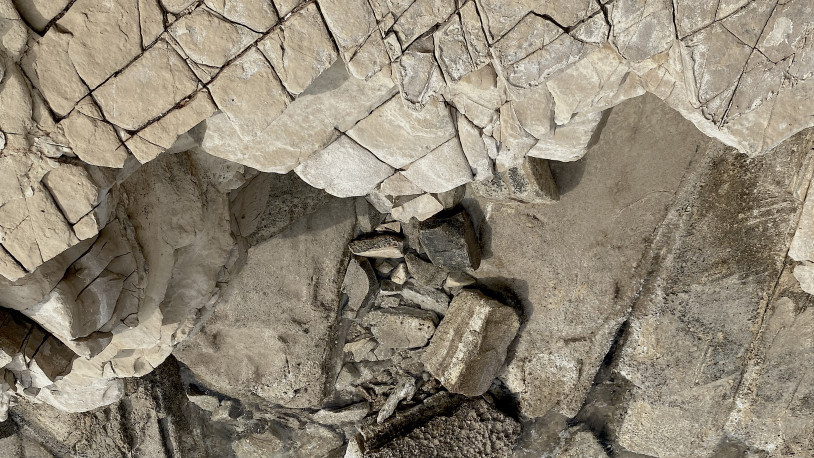
↓ 11,014 m
The drill bit passed through a thin layer of compact rock and encountered no further resistance. A current of air rose through the borehole. The optical probe descended several kilometres into the darkness until a concave surface came into view, crossed by mountain ridges and vast depressions.
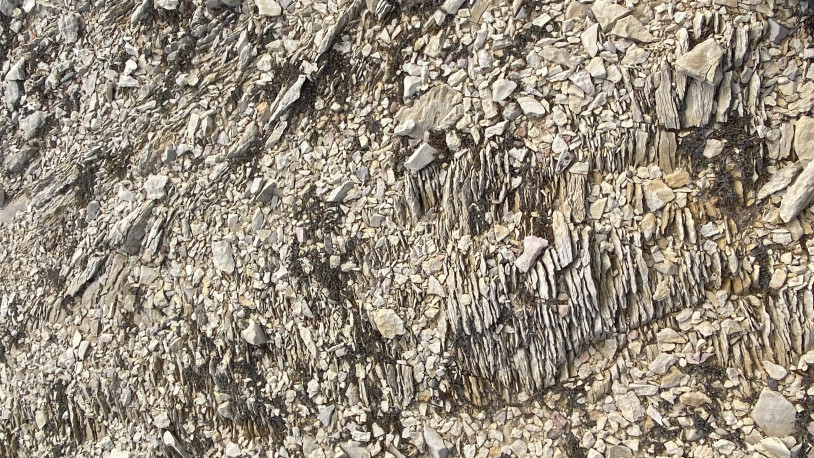
The Earth contained an immense cavity.
↓ ∞ — Hollow Earth
The initial survey revealed a landscape in which gravity had no consistent direction. Vast mountain ranges projected from the inner face of the crust, pointing towards the planet’s centre. Some ended in suspended spires; others branched into slender structures resembling the roots of mineral organisms. Lens-shaped bodies of water extended between the mountains. In some regions, liquids clung to the rock surface; elsewhere they formed suspended masses, threaded by currents that slowly altered their geometry.
The landscape was illuminated by diffuse light with no central source. Spectroscopic analyses identified extensive concentrations of luminescent minerals and biological colonies capable of emitting visible radiation. Variations in the magnetic field accompanied cycles of light that moved slowly across the vault. Some mountains remained illuminated for weeks, while others sank into almost complete darkness. The inhabitants had developed a chronology based on these intervals, independent of the day–night cycle on the Earth’s outer surface.
The probe passed through a region of vast siliceous slabs separated by fissures hundreds of metres deep. The surfaces contained quartz, magnetite, aragonite and unknown minerals whose crystal lattices assumed configurations unlike any observed on the outer surface. Some aggregates grew through successive episodes of deposition; others through mineral replacement, as the original material was gradually consumed and reorganised without significant change in its overall volume. The oldest rocks did not necessarily occupy the deepest regions. New deposits formed on walls, on suspended surfaces and along the boundaries between zones subject to different gravitational conditions.
In a valley crossed by luminous filaments, the first life forms appeared. They were sheet-like organisms, anchored to the walls by mineralised structures. They incorporated calcium, silicon and metals dissolved in the water, developing crystalline coatings that gradually thickened. Once they reached a certain size, they detached from the substrate and migrated through the cavity, orienting themselves according to variations in the magnetic field. Some exceeded the size of a building. As they moved, they shed portions of their coatings, which settled on the surfaces below and formed new stratified sequences. A substantial part of the landscape was therefore the product of the growth, migration and decomposition of organisms capable of producing rock.
Farther on, structures appeared along an almost vertical wall. They were neither carved into the mountain nor set upon the ground: they seemed to grow directly from the rock through branching columns, mineralised membranes and thin translucent surfaces. The structures grew through the controlled deposition of crystals, following geometries that distributed stresses without conventional load-bearing systems. Some extended for kilometres along the vault, linked by suspended passageways; others penetrated the crust through regularly shaped openings.
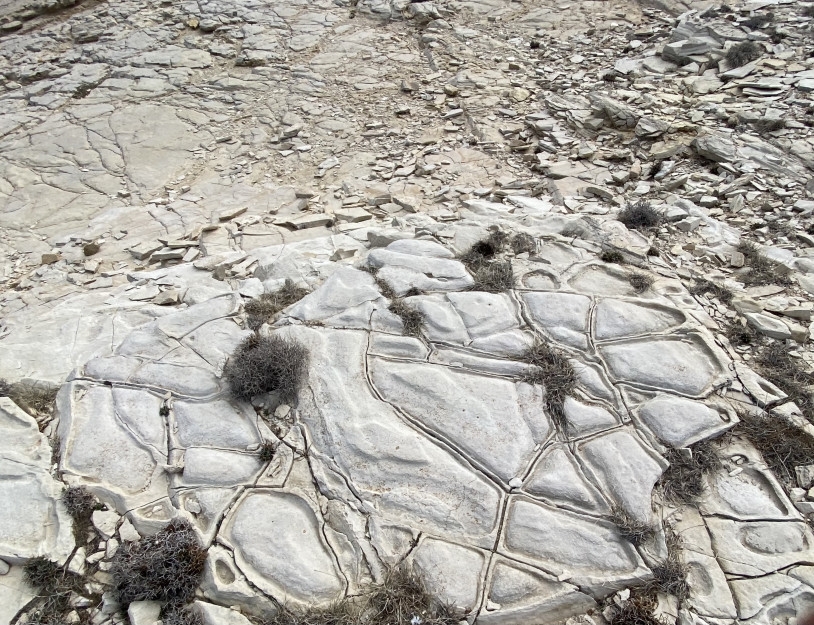
The inhabitants built not by removing material but by directing its growth. They used organisms capable of precipitating minerals in predetermined configurations, producing walls, conduits, transparent surfaces and movable elements. Their cities were still-active geological systems. Every building had an age, a mineralogical composition and a history of transformations recorded in its structure. The oldest dwellings could be recognised by their accumulated layers; abandoned ones continued to grow, gradually incorporating surrounding artefacts and organisms.
The civilisation of the interior had developed a form of cartography based not on elevation or distance but on the continuity of surfaces. Two regions that appeared close together could be separated by impassable discontinuities; others, immensely far apart, were connected by openings in which spatial extent lost its meaning. Routes followed fractures, mineralogical contacts and regions of gravitational equilibrium. Territories were represented through geological cross-sections in which each route was described by the succession of materials traversed.
Eventually the probe reached a plateau where thousands of rock cylinders were arranged in concentric sequences. Beside each series was a borehole. The inhabitants had carried out core drilling from their own surface outwards, through the crust in the opposite direction to that followed by the team on Lipsi. Their samples contained comparable lithologies: limestones, phyllites, quartzites, gneisses and more recent sediments. Their classification, however, followed an inverted chronology. For the geologists of the interior, the oldest formations lay towards the vault, while the more recent ones occupied progressively deeper levels.
On some surfaces, the seven-segment figure appeared.
The team recognised the outline first detected in the rock pavements of Lipsi. The heptagonal openings were neither mineral inclusions nor artificial symbols, but cross-sections of a system of connections running through the crust and linking regions separated in space and time. The inhabitants of the interior had used them for an incalculable span of time. Some seemed older than the sedimentary sequences enclosing them, because they joined portions of matter belonging to different chronologies.
On the plateau, the last borehole was still active. A cylinder of gneiss bearing the same heptagonal outline was extracted. Shortly afterwards, the drilling apparatus on Lipsi brought an identical core to the surface, even though drilling had stopped.
The two cylinders had complementary surfaces, but isotopic dating yielded incompatible ages.
Through an audiovisual link established along the borehole, the inhabitants of the interior showed the team their reconstruction of the planet. For centuries, they had hypothesised that beyond the rocky vault lay even deeper regions, inhabited by organisms capable of living beneath an outer sky. Some of their ancient models depicted the Earth as a succession of concentric spheres separated by traversable spaces. Others imagined great conduits carrying water and fire between the planet’s different levels.
The similarities to Hollow Earth theories developed on the outer surface in previous centuries were striking. Both civilisations had inferred the existence of the other through the observation of geological phenomena, without ever encountering its inhabitants. Yet both accounts were incomplete. The planet was not a single shell enclosing one vast empty space: it contained a succession of inner surfaces, some inhabited, others still forming, separated by cavities of varying extent.
The expedition had reached only the first.
Subsequent images revealed, beyond the luminous mountains and mineralised cities, a second surface suspended within the immense cavity. It had continents, bodies of water and a thin atmosphere. Spectroscopic analyses indicated materials consistent with some of the oldest rocks recovered on Lipsi, but with unfamiliar isotopic signatures.
The inhabitants of the interior reported that the region had already been explored. Other civilisations occupied still more remote surfaces, separated by intervals whose extent varied with magnetic and gravitational conditions.
The team on Lipsi realised that their drilling had not reached the centre of the Earth, but the first boundary of a geological territory far more extensive than anything previously imagined.
The final report retained all depths measured down to 11,014 metres. Beyond that depth, new environments, mineralogical successions, organisms and settlements were recorded, but it was no longer possible to assign them an unambiguous distance from the surface.
The entry for Earth’s centre was left blank.
The last image transmitted by the probe showed a city grown along the vault, with crystalline walls and suspended streets. Above it, through a vast heptagonal opening, a stretch of rocky coastline could be seen in sunlight. It was Lipsi.
The pale rocks, polygonal fractures and beds extending towards the sea occupied the same positions documented in the photographs taken before drilling began. The inhabitants of the interior had been observing that surface for an incalculable span of time.
To them, the coastal rock pavements were not geological outcrops.
They were openings in the ceiling of the world.
Note: The documentation includes notes and materials gathered through field research, meetings and conversations with local residents, alongside bibliographic research and further reading, together with photographs taken during the study trip to Greece between mid-September and 7 November 2021.
The materials presented document an ongoing research process and form part of an evolving archive, whose contents will continue to be expanded, developed and revised until the completion of the final artwork, scheduled for late 2029.