

The Genealogy of Strangers
Among five sarcophagi flanking a paved road in the necropolis of Paros, the skeleton of an animal was discovered. In 1998, the Chronique des fouilles en Grèce, published in the Bulletin de Correspondance Hellénique, identified it as a wild boar, drawing comparisons with animal remains found on Naxos. The following year, Gilles Touchais published a brief correction in the same journal: the bones belonged to a small horse. No explanation accompanied the amendment. We do not know who made either identification or what observations prompted the revision. The bones had remained the same. The animal had changed.
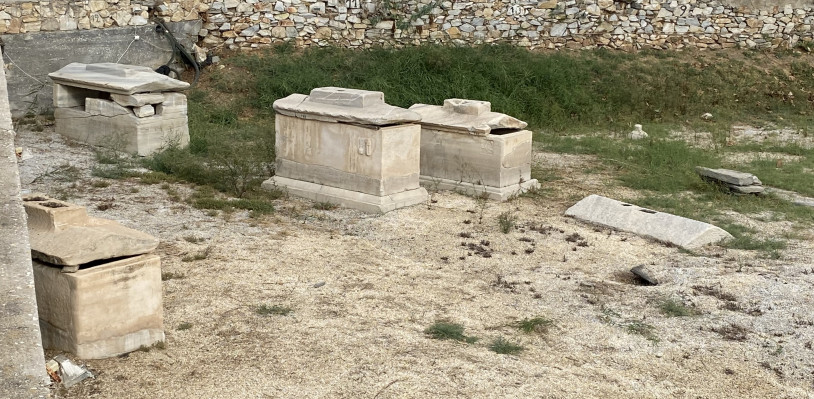
Establishing the original associations of the surrounding sarcophagi is more complicated. Over the centuries, their chests, lids and fragments have been separated and rearranged. Some lids, broken or out of alignment, rest on overlapping fragments; others appear to have lost their original counterparts. The initial configurations cannot always be reconstructed.
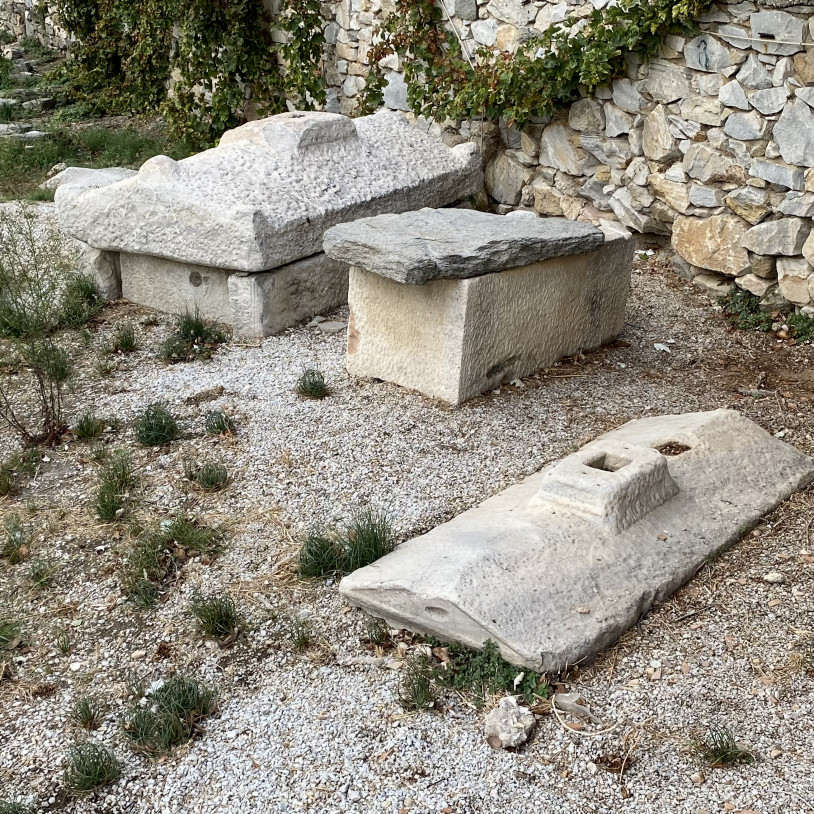
The lids resemble miniature pitched roofs, with raised sections containing rectangular sockets. Otto Rubensohn interpreted these as supports for marble busts of ancestors; other scholars have proposed funerary stelae or fittings used in offerings. One slab retains two adjacent openings, but none of the elements they may once have held has been identified.
Some sarcophagi on Paros were intended to accommodate several members of the same family. Their marble surfaces were divided into figural panels bearing representations of individuals and commemorative inscriptions. It has also been suggested that certain Roman-period decorations were carved onto earlier sarcophagus chests.
A discovery near the Katapoliani documents a more radical transformation. In the winter of 1971–72, a funerary stele was found that had been cut from the side of an older sarcophagus. It depicted a man and a child, both standing. The stonecutters had preserved the figures, trimmed the sculpted wreath and altered the inscription, replacing the original name.
Along the right edge, a groove four centimetres wide remained, once separating the relief from another panel. The adjacent figure had been removed. The stele thus retained two figures reassigned to a new burial, together with the boundary of a presence excised from the composition.
The reasons for this reuse are unknown. The sarcophagus may have been damaged, abandoned or salvaged for its marble. Whatever the circumstances, the intervention produced a monument in which the earlier image and the later inscription belonged to different phases of commemoration. The faces did not need to be altered for the figures to acquire another name.
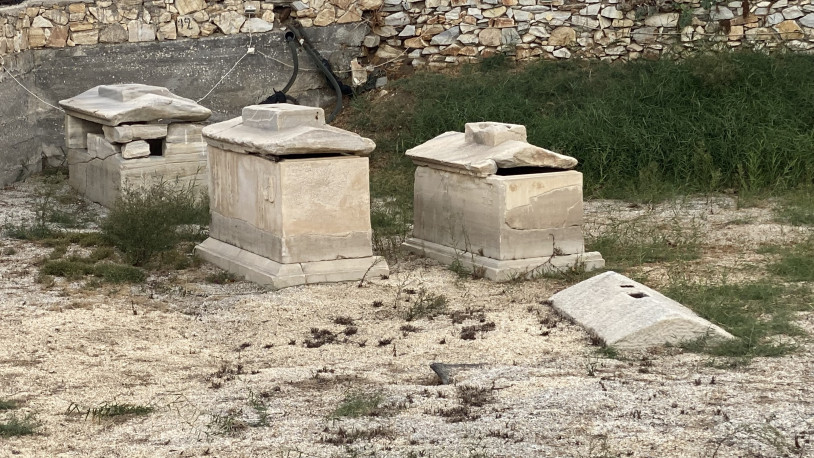
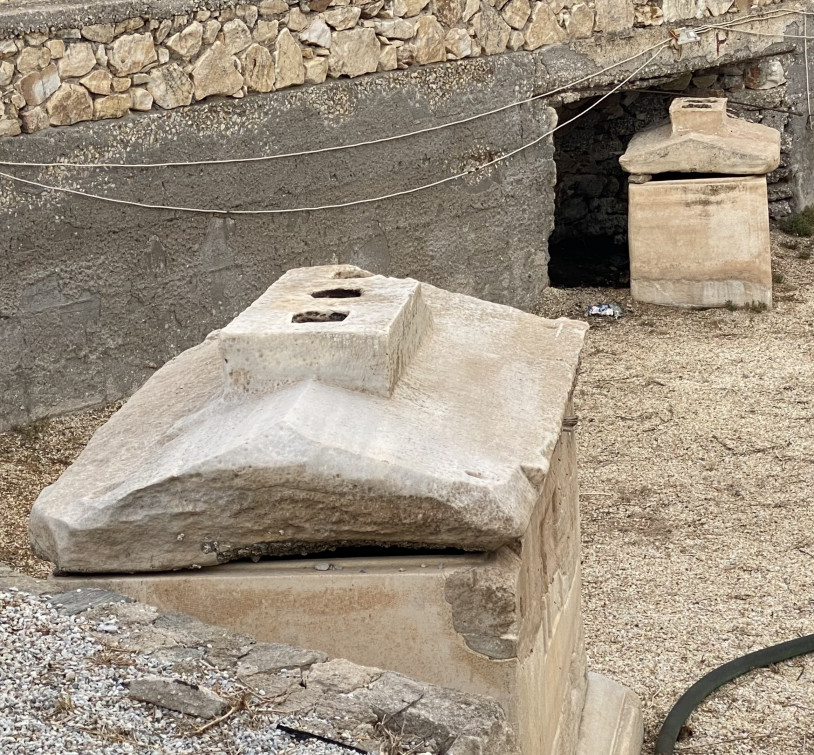
At the Vitzi necropolis, misaligned lids and isolated slabs suggest further alterations whose sequence can no longer be established. The stele depicting the man and child preserves at least four centimetres of its former composition. With the other monuments, we no longer know even where to look for the cut.
Historical Note
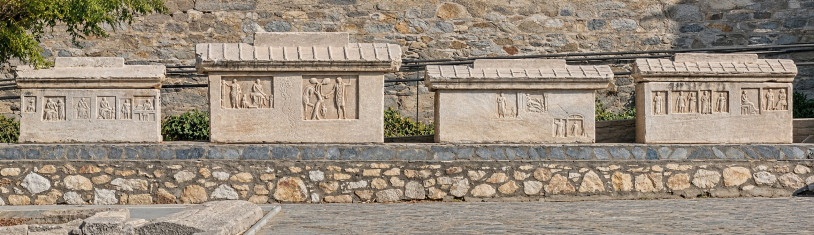
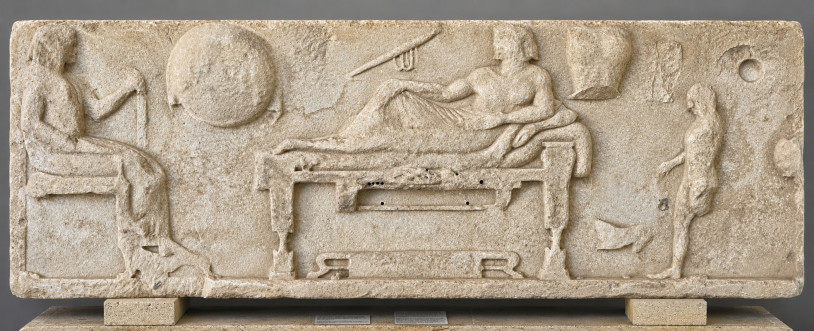
The Vitzi necropolis (Βίτζι), near the ancient harbour of Parikia, provides evidence of prolonged funerary use, from the Protogeometric period through to the Roman era. Systematic excavations conducted by Fotini Zapheiropoulou from 1983 onwards have helped establish its extent, the distribution of burials and changes in funerary practices.
Among its most significant complexes are two eighth-century BCE polyandria, monumental collective burials containing cremated human remains deposited in amphorae. Osteological analyses have identified predominantly adult males, some bearing injuries consistent with episodes of violence. The pottery decoration includes geometric patterns and figurative scenes, sometimes interpreted in connection with collective commemorative practices and the emergence of the earliest civic institutions of the polis.
The archaeological record attests to a range of burial practices, including urn cremations, cist graves, pit inhumations, infant burials in ceramic vessels (enchytrismoi) and sarcophagus burials. Investigations in neighbouring areas also indicate that the necropolis originally extended well beyond the boundaries of the site accessible today.
The Part Taken Away
In the ninth century, a young nun from Lesbos, captured during a raid by Arab pirates, escaped when their ship called at Paros. Her name was Theoktiste. According to her Life, she spent the next thirty-five years hidden among the ruins of the Katapoliani, surviving on lupins and wild herbs. Her clothes wore away until nothing remained. When a hunter encountered her, her hair was entirely white, her face darkened, and her skin clung so tightly to her bones that almost her entire skeleton was visible. She was scarcely recognisable as human.
Theoktiste asked him to throw her a cloak so that she could cover herself and, before he departed, to return the following year with the Eucharist. The hunter kept his promise, but when he came back to bid her farewell, he found her dead. Convinced that he had encountered a saint, he decided to preserve a relic: he severed one of her hands, wrapped it in cloth and took it with him.
The ship he boarded could not leave the harbour. The wind was favourable, the sails were set, yet the vessel remained motionless. The hunter returned to the church and restored the hand to the body. Only then could the ship depart.
When he told his companions what had happened, they wanted to see the burial place. They returned to the island, but Theoktiste's body had vanished. According to tradition, only the impression of her figure remained in the ground.
The hunter had tried to carry away part of the saint, but the severed hand had prevented his departure. Once it was returned, the entire body became untraceable. The only surviving trace could neither be collected nor carried elsewhere.
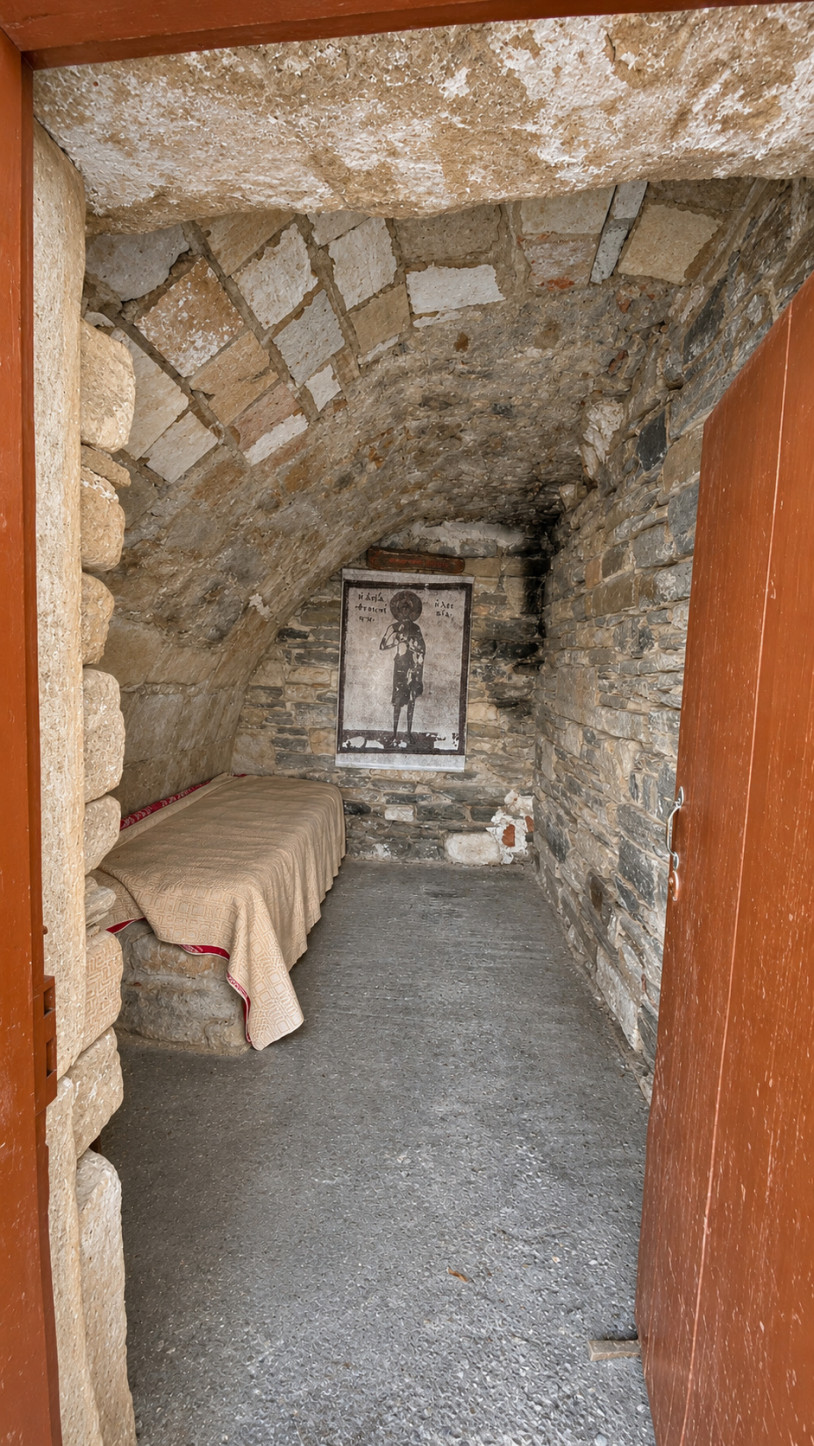
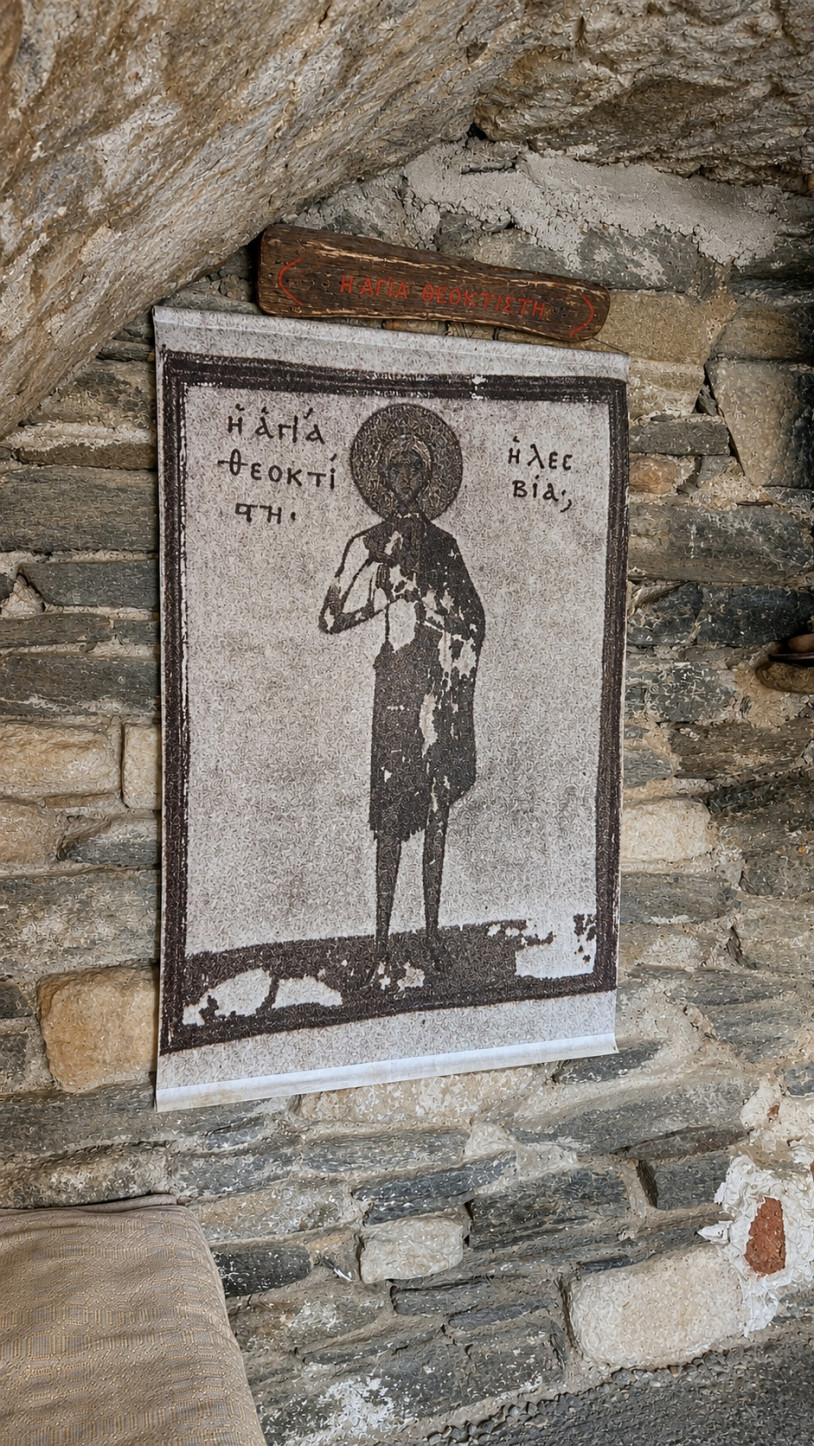
Within the Katapoliani, a small chamber is now associated with the memory of Theoktiste, although it cannot be established whether it corresponds to any of the spaces she inhabited. Her Life describes her long residence among the ruins without identifying a location that can be established with certainty.
For thirty-five years, no one had known where to look for her. After her death, when the place where she had lain finally became known, there was no longer a body to identify. Those who returned could find only the shape it had left in the earth.
At their first encounter, the hunter had needed to cover her before he could look at her. At the last, there was nothing left to cover.
The Undisclosed Contents
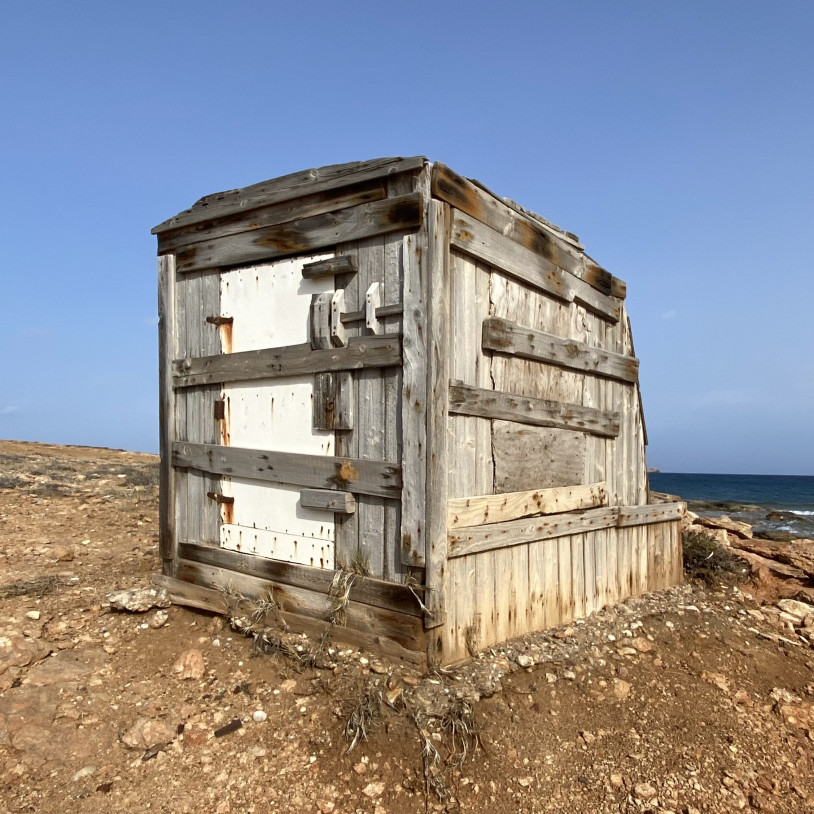
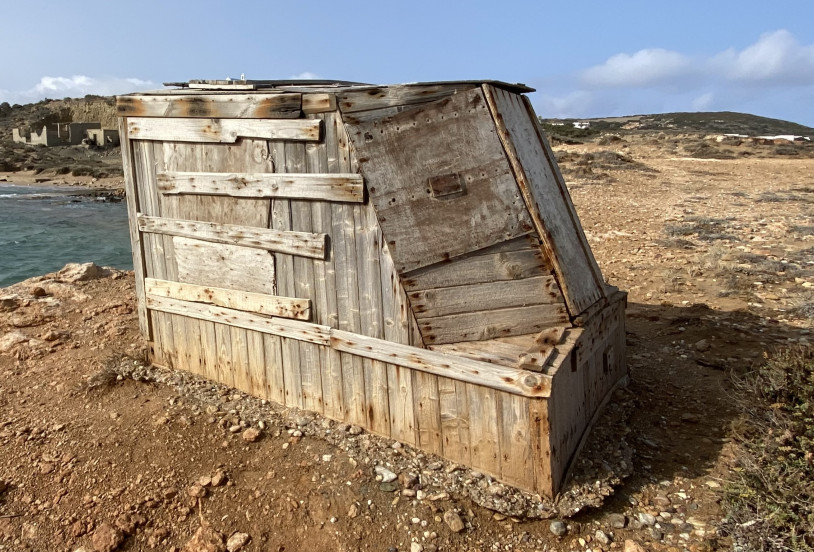
On a headland on Paros, a wooden structure conceals something from view. It might hold an ordinary piece of equipment, a forgotten artefact or an object for which no existing classification would suffice. Seven interpretations assign it seven different identities, moving between history, the natural sciences, literature, archaeology, science fiction, meteorology and myth.
The Last Transmission
A metal box contains military documents from the Second World War: nautical charts, communications logs, evacuation orders and a coded message that was never transmitted. During the Italian and subsequent German occupation of the Cyclades, control of the sea routes was essential to maintaining connections between the islands. Coastal observation posts monitored maritime traffic, recorded sightings and transmitted reports.
The message orders the evacuation of a position absent from every surviving chart. The coordinates are correctly formatted but designate a point in open water. The document bears the signature of an officer whose name appears on none of the personnel lists for the archipelago. The evacuation order specifies neither how many men were stationed there nor how they were supposed to leave.
The Zero Sample
A cylindrical rock core extracted vertically from the headland contains deposits of differing composition, preserving evidence of relative sea-level fluctuations and the island's geological history.
Analysis reveals a thin sedimentary layer containing mineral particles of unusual composition. Their concentration increases with depth, while dating assigns the deposit an age incompatible with the surrounding stratigraphic sequence. The core is designated zero because none of the known stratigraphic horizons provides a consistent chronological reference.
In its deepest section, a perfectly smooth surface appears, devoid of lamination, inclusions or traces of abrasion. It does not even share the texture of the rock in which it is embedded. Its origin predates every event that the core allows researchers to date.
The Divergent Manuscript
A manuscript consisting of a single sheet, folded hundreds of times according to a geometry that allows it to be unfolded without breaking its continuity. It has neither chapters nor pagination. Sentences are linked by a system of cross-references that traverse the folds, bringing together words written on portions of the surface that were originally far apart.
Reading requires the sheet to be unfolded in a particular sequence. Each choice changes the order in which subsequent passages become accessible and makes it impossible to retrace the previous route in its entirety. There is no first page, only a multitude of beginnings, each rendering certain parts of the text inaccessible.
The author left a single instruction: the manuscript must be read by one person at a time. Two readers attempting to unfold different sections simultaneously would produce incompatible texts, each containing an exact account of the other's reading.
The Negative of a Statue
A block of stone contains a cavity in the shape of a human figure. Its inner surface reproduces minute details: individual strands of hair, fingerprints, irregularities in the skin. The precision exceeds what could ordinarily be achieved through ancient mould-making techniques.
There are no indications of clothing or iconographic attributes that might help establish a date. The proportions correspond to those of an adult, but certain anatomical features have no counterpart in known human morphology.
Between the fingers is the negative impression of a small object. A three-dimensional reconstruction reveals its form: a second human figure, identical to the first but reduced in scale. It too holds something in its hands. The resolution of the scan is insufficient to determine whether it is a third figure.
The External Organ
An artificial biological organ, developed to perform a function absent from human anatomy. It consists of cultured tissues, photosensitive membranes and a network of filaments capable of detecting electromagnetic fluctuations and converting them into biological signals.
It belongs to no particular individual. It can be temporarily connected to different organisms and transmit information through an interface independent of conventional sensory pathways. During experiments, subjects report perceptions of places they have never visited and memories of events that have yet to occur.
The organ is detached from its final host when the subject begins to describe the following twenty-four hours with precision. Once removed, it continues to record sequences of signals corresponding to future events. The recordings, however, no longer concern the subject: they describe changes in the organ's own tissues, including those caused by experiments that have yet to be performed on it.
The laboratory thus possesses an advance record of its own procedures, but cannot consult it without altering the experiments it describes.
The Preserved Wind
A vessel contains a mass of air collected during an exceptional storm. A compensation system maintains constant pressure and temperature, while a confinement field preserves the original distribution of turbulent motion.
The objective is not to analyse the chemical composition of the atmosphere, but to preserve a meteorological event: an unrepeatable configuration of turbulence, humidity, pressure gradients and electrical charges. Rather than a simple air sample, the vessel contains the evolving structure of the storm.
During the event, there had been a seventeen-second interval in which every weather station on the island recorded identical readings. Pressure and temperature converged regardless of altitude, while wind speed simultaneously fell to zero at every station.
The anomaly was initially attributed to a malfunction in the monitoring network. Yet the sample continues to reproduce those seventeen seconds, during which the particles remain suspended while retaining their kinetic energy.
The storm did not stop. For seventeen seconds, it produced no wind.
The Bone of a Siren
A long, curved bone, worn smooth by the sea, with no articular ends corresponding to any known skeleton. One end is hollow and, when air passes through it, produces a low sound resembling a voice heard underwater.
In archaic Greek iconography, Sirens were hybrid beings with human heads and birds' bodies. Their later assimilation to marine creatures with fish tails profoundly changed how they were imagined, represented and recognised.
The bone appears to belong to both anatomies. Its internal structure is consistent with the pneumatic bones of birds, while its outer surface bears markings resembling the sites of muscular attachment in a marine mammal.
One possible interpretation of the specimen reverses the conventional sequence of images: the Sirens did not change form over the centuries. Their successive representations preserved only those anatomical features that each period was capable of recognising.
The bone would be the first fragment to have escaped this selection.
Note: The documentation includes notes and materials gathered through field research, meetings and conversations with local residents, alongside bibliographic research and further reading, together with photographs taken during the study trip to Greece between mid-September and 7 November 2021.
The materials presented document an ongoing research process and form part of an evolving archive, whose contents will continue to be expanded, developed and revised until the completion of the final artwork, scheduled for late 2029.